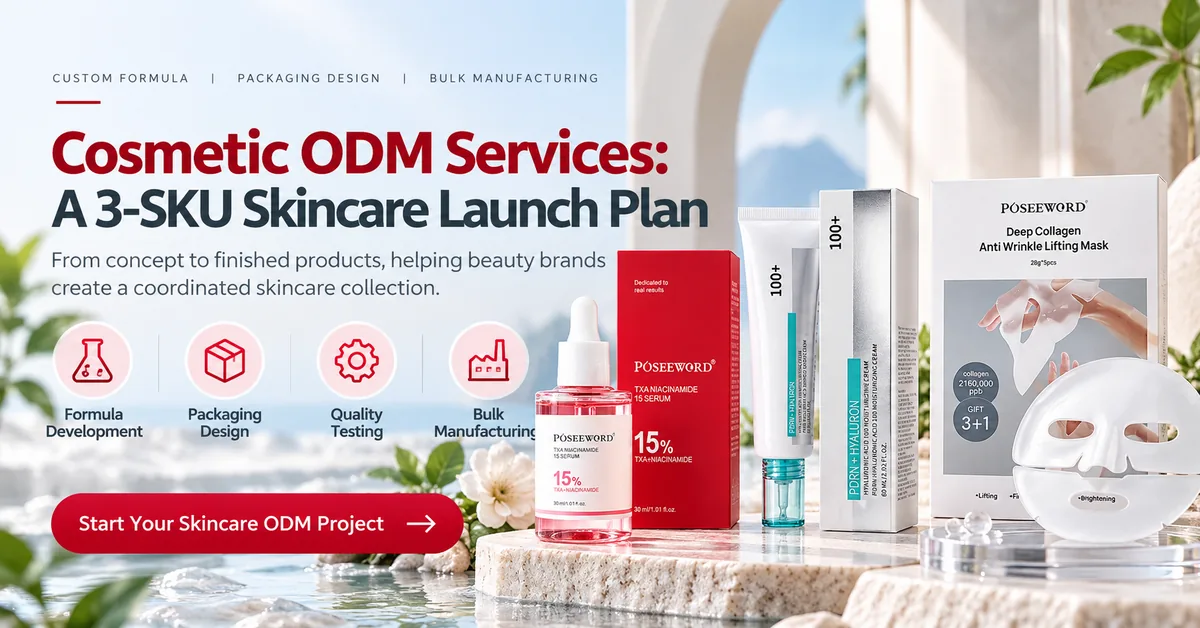
Cosmetic ODM services help beauty brands develop market-ready cosmetic products by coordinating formulation, product design, packaging, sampling, testing, and manufacturing. Rather than sourcing each activity independently, a brand can work with an ODM development partner to turn one commercial concept into a coordinated product collection.
For new skincare brands, an effective approach is to begin with three complementary SKUs: a facial serum, a moisturizer, and a facial mask. This creates a manageable product range while providing opportunities for different retail price points, consumer routines, and sales channels.
However, a successful ODM project requires more than selecting ingredients and adding a logo. Brands must align product positioning, formula feasibility, packaging, quality requirements, ownership terms, manufacturing costs, and target-market responsibilities before approving production.
This guide explains how international beauty brands can structure a three-product ODM project and make better sourcing decisions.
1. What Are Cosmetic ODM Services?
Cosmetic Original Design Manufacturing (ODM) is a business arrangement in which a manufacturing partner participates in developing the product solution rather than only producing against a fully specified formula supplied by the customer.
Depending on the agreement, cosmetic ODM services may include:
-
Product concept development and market positioning.
-
Existing formula selection or customized formulation.
-
Ingredient and texture development.
-
Laboratory sampling and formula revisions.
-
Packaging material selection and brand design.
-
Product testing and quality specification development.
-
Manufacturing, filling, labeling, and packaging.
-
Production documentation and subsequent product optimization.
The actual service scope varies by manufacturer and project.
An important distinction is that ODM does not automatically mean a completely exclusive formulation. The buyer must confirm whether the project involves an established formula, a modified formula, or a newly developed formula, as well as the applicable ownership and usage rights.
For a beauty brand, the objective is to develop a commercially viable product portfolio without separately managing every technical task.
2. Why Build a Three-Product Skincare Line With ODM Support?
Launching too many products at once can increase inventory exposure, packaging expenditure, sampling complexity, and operational pressure.
A three-SKU strategy gives brands a more focused starting point.
For example, a collection could contain:
-
A facial serum positioned as the hero product.
-
A daily moisturizer supporting the routine.
-
A facial mask designed for complementary or occasional care.
The products should serve related customer needs while remaining distinct enough to justify separate purchases.
How a Focused Product Portfolio Supports Commercial Planning
| Business Objective | Three-SKU Strategy | Potential Commercial Benefit |
|---|---|---|
| Establish a hero product | Make the serum the central product | Concentrates product messaging |
| Build a routine | Add a complementary moisturizer | Creates logical cross-selling opportunities |
| Add a differentiated format | Introduce a facial mask | Supports bundles and promotional campaigns |
| Manage purchasing | Plan three defined products | Makes development priorities clearer |
| Control investment | Approve each SKU individually | Reduces unnecessary early commitments |
| Plan replenishment | Track demand by product | Supports future purchasing decisions |
These benefits depend on actual consumer demand, costs, and execution. A three-product launch does not guarantee higher sales or lower total costs.
It does, however, provide a clear framework for coordinating product development.
3. Which Beauty Businesses Benefit Most From ODM Development?
Different buyer groups can use the same development framework for different business objectives.
Emerging Beauty Brands
New brands may have a strong market concept but limited experience in cosmetic formulation, packaging procurement, and manufacturing management.
ODM support can help translate a commercial brief into more specific product-development requirements.
Established Skincare Companies
Existing brands may use ODM development to expand into complementary categories, introduce new textures, or develop products for additional customer segments.
Cosmetic Importers and Distributors
Importers may need coordinated products with suitable packaging, documentation, and specifications for particular regional markets.
E-Commerce and Private Label Businesses
Online beauty brands often require differentiated product positioning, consistent packaging presentation, and clear product information for their retail channels.
Salons and Professional Beauty Suppliers
Professional buyers may prioritize product format, application experience, packaging hygiene, and predictable replenishment.
When ODM may not be appropriate: A company that already owns a complete formula, finished packaging specifications, and manufacturing instructions may require a conventional OEM production arrangement rather than extensive product development.
4. Example: Developing a Three-SKU Skincare Collection
The most useful way to understand a complete ODM project is to examine how several different products can fit into one brand concept.
Huanqiutongmao's existing cosmetic product catalog provides reference products across facial serums, moisturizers, masks, and other skincare formats.
The following example uses three published products as development references. It is an illustrative portfolio strategy, not a claim that all three are already sold as a pre-approved ODM set.
SKU 1: Niacinamide Facial Serum — The Hero Product
A facial serum can establish the collection's central ingredient story.
The published Niacinamide Serum 30ml features niacinamide and betaine in a lightweight serum format.
For a customized development project, buyers might discuss:
-
The intended niacinamide formulation approach.
-
Moisturizing and skin-conditioning ingredients.
-
Desired texture and absorption characteristics.
-
Fragrance preferences.
-
Dropper or pump packaging options.
-
Target product cost and net content.
Any proposed changes must be evaluated for feasibility and stability.
SKU 2: PDRN Hyaluronic Acid Cream — The Daily Moisturizer
A moisturizer can complement a serum while providing a different sensory experience.
The published PDRN Hyaluronic Acid Moisturizing Cream is presented as a moisturizing cream incorporating PDRN and hyaluronic-acid-based skincare ingredients.
Development considerations may include the cream's texture, emollient system, hydration-focused positioning, packaging, and ingredient documentation.
Where PDRN is proposed, buyers should verify the precise ingredient identity, origin, specifications, and intended-market requirements rather than rely solely on the ingredient name.
SKU 3: Two-Piece Collagen Mask — The Complementary Treatment
The Two-Piece Collagen Mask uses separate upper and lower facial sections with a collagen-focused essence.
Its individual sachet packaging provides a different product format from the serum and moisturizer.
For ODM planning, the brand could evaluate mask material, essence composition, packaging artwork, facial fit, and filling requirements.
This makes the mask a potential complementary product for retail bundles, salon channels, or e-commerce promotions.
Three-SKU Product Development Comparison
| Technical Item | Facial Serum | Moisturizing Cream | Two-Piece Mask |
|---|---|---|---|
| Product reference | Niacinamide serum | PDRN + hyaluronic acid cream | Collagen facial mask |
| Product format | Liquid serum | Cream emulsion | Essence-soaked facial mask |
| Published specification | 30ml | Cream format; project size to confirm | Two-piece design, individual sachet |
| Formula priority | Ingredient compatibility and texture | Emulsion and sensory stability | Essence and mask-material compatibility |
| Packaging priority | Dispensing and container compatibility | Filling, closure and product protection | Sachet integrity and sealing |
| Quality focus | pH, appearance, viscosity as applicable | Emulsion consistency and stability | Microbiological quality, essence quantity and sealing |
| Commercial role | Hero product | Routine companion | Complementary treatment |
All final specifications must be approved for the actual ODM project.
5. How Do Cosmetic ODM Services Turn a Product Brief Into Finished Products?
A structured project should have clearly defined deliverables and approval responsibilities.
The following process is a recommended development framework.
Stage 1: Product Strategy and Market Brief
The brand establishes the target consumer, intended market, product benefits, retail positioning, planned sales channels, and budget.
Deliverable: Approved product development brief.
Stage 2: Formula Route Selection
The development team evaluates whether each SKU should use an existing formula, a modified formula, or newly developed formulation.
Deliverable: Formula strategy for each SKU.
Stage 3: Laboratory Sample Development
Samples are prepared for evaluation of product appearance, texture, odor, dispensing behavior, and other agreed attributes.
Deliverable: Documented sample feedback and revision decisions.
Stage 4: Packaging and Brand Design
The project defines primary containers, closures, secondary packaging, artwork, labels, and any relevant compatibility requirements.
Deliverable: Approved packaging specifications and artwork.
Stage 5: Testing and Manufacturing Feasibility
The team determines which stability, microbiological, packaging, safety, and manufacturing evaluations are applicable.
Deliverable: Agreed testing plan and manufacturing acceptance criteria.
Stage 6: Commercial Manufacturing Preparation
Materials, minimum quantities, costs, production scheduling, and quality requirements are confirmed.
Deliverable: Approved commercial order and production specifications.
Stage 7: Production, Quality Control, and Delivery
Manufacturing proceeds according to the agreed specifications, followed by relevant inspections and release activities.
Deliverable: Finished products and agreed supporting documentation.
Not every project requires identical activities or timing. The sequence should be adapted to the product and its technical risks.
6. Choosing the Right ODM Formula Development Route
One of the most important commercial decisions is how extensively each product should be customized.
| ODM Development Route | Main Characteristics | Advantages | Considerations |
|---|---|---|---|
| Existing formula with branding | Uses an established product formula | Fewer initial development decisions | Limited formula differentiation |
| Modified existing formula | Adjustments to an existing formula | Balance between customization and established development resources | Modifications may require new testing |
| New custom formulation | Develops a formula around specific requirements | Greater flexibility in product positioning | More development work, cost and technical uncertainty |
For a three-product collection, brands do not necessarily need the same development route for every SKU.
For example, a company might choose a more customized serum while using established formula references for its moisturizer and mask.
This hybrid strategy can focus development spending on the product with the highest potential differentiation.
However, the final selection should depend on product feasibility, agreed intellectual property terms, testing requirements, and commercial priorities.
7. What Technical Specifications Should an ODM Skincare Project Include?
An attractive sample alone is not a complete product specification.
A professional ODM brief should identify measurable characteristics that can be used during sample approval, production, and future reorders.
Recommended Technical Specification Checklist
| Specification | Information to Confirm | Why It Matters |
|---|---|---|
| Product type | Serum, cream, mask or other format | Defines the manufacturing approach |
| Formula reference | Approved formula and revision | Prevents uncontrolled modifications |
| Ingredients | INCI information and key material specifications | Supports technical and documentation reviews |
| Appearance | Color, clarity and product uniformity | Provides quality reference |
| Texture | Relevant viscosity and sensory characteristics | Supports product consistency |
| pH | Product-appropriate range where relevant | Helps manage formulation characteristics |
| Fragrance | Type, concentration or fragrance-free requirement | Supports consistency and labeling |
| Net content | Approved fill quantity | Supports packaging and commercial accuracy |
| Packaging | Container, closure, material and decoration | Affects compatibility and appearance |
| Testing | Relevant stability, microbiology and safety evaluations | Helps assess product suitability |
| Quality criteria | Agreed acceptance specifications | Supports batch approval |
Actual numerical values should come from the approved product specification and supporting test results.
Huanqiutongmao describes its formulation research, laboratory resources, stability evaluation, microbiological testing, and physicochemical testing on its R&D and Production page.
These capabilities are relevant to ODM project discussions, although individual test programs and project deliverables must be confirmed.
8. Coordinating Packaging Design Across Multiple SKUs
A coordinated skincare collection should look consistent without forcing every product into the same packaging format.
For example, a serum may use a dropper bottle, a moisturizer may use a tube, and a mask may require a sealed sachet.
The brand can still maintain visual consistency through colors, typography, graphics, and packaging structure.
Packaging Decisions That Affect ODM Costs
Standard versus custom components: Standard packaging may reduce the need for specially developed components, while custom designs may require tooling, minimum purchases, or additional approval work.
Decoration and printing: Screen printing, labels, cartons, and other decorative methods have different setup and production considerations.
Formula compatibility: Container materials must be appropriate for the formulation and expected storage conditions.
Inventory management: Packaging materials may have different minimum order quantities from the cosmetic formulation itself.
Market requirements: Label language, ingredient information, warnings, and other mandatory details must be appropriate for the intended destination.
Huanqiutongmao's Design and Planning page describes product strategy, packaging material recommendations, brand design, and related support.
For a three-SKU development project, brands should approve a coordinated packaging plan while maintaining a separate technical specification for every product.
9. What Quality and Regulatory Checks Matter Before Launch?
An ODM partner can contribute formulation expertise and manufacturing documentation, but responsibility for market access must be clearly allocated.
Requirements differ by destination, product category, ingredients, and intended claims.
Formulation and Packaging Testing
Depending on the product, relevant evaluations may include:
-
Stability under appropriate storage conditions.
-
Physical and chemical characteristics.
-
Microbiological quality and preservative effectiveness where applicable.
-
Packaging compatibility and leakage resistance.
-
Relevant product safety evaluations.
-
Evidence appropriate to proposed cosmetic claims.
Huanqiutongmao's Manufacturing Capabilities page describes raw material inspection, packaging compatibility evaluation, and semi-finished and finished-product quality checks.
International Quality and Market Requirements
ISO 22716:2007 provides guidance on Good Manufacturing Practices for cosmetics, including production, control, storage, and shipment. Buyers should request evidence before accepting any claim of certification.
For cosmetics placed on the EU market, Regulation (EC) No 1223/2009 establishes responsibilities involving product safety, designated responsible persons, documentation, labeling, and notification.
For the United States, applicable requirements under the Modernization of Cosmetics Regulation Act of 2022 may include facility registration, product listing, and safety substantiation, subject to relevant exemptions.
FDA registration or product listing does not constitute FDA product approval.
The key purchasing principle: Ask the ODM provider which documents and testing activities it can support, which are provided by external specialists, and which remain the responsibility of the brand or importer.
10. How Much Do Cosmetic ODM Services Cost?
There is no reliable universal price for cosmetic ODM development because costs depend on the formula route, packaging, testing, production quantity, and service scope.
A useful quotation should separate development expenses from recurring manufacturing expenses.
ODM Project Cost Structure
| Cost Category | Typical Cost Drivers | Recommended Buyer Action |
|---|---|---|
| Product development | Formulation complexity and revisions | Define sampling scope |
| Ingredients | Grade, specifications, supplier availability | Confirm approved material requirements |
| Testing | Stability, compatibility, safety and related evaluations | Identify necessary tests |
| Packaging | Components, printing, decoration and tooling | Compare standard and customized options |
| Production | Batch size, processing and filling | Request SKU-specific quotations |
| Quality control | Inspection and documentation scope | Define required deliverables |
| Logistics | Packing, freight and shipping terms | Confirm commercial delivery basis |
MOQ Planning for Three Different Products
A common mistake is assuming that the MOQ of one SKU automatically applies to the entire collection.
A serum, a cream, and a sachet mask may involve different production quantities and packaging minimums.
Brands should request separate minimum order quantities for each product, as well as any additional requirements for printed packaging.
When comparing proposals, calculate the overall launch investment rather than evaluating the filling price alone.
A lower unit price may not provide better commercial value if it requires excessive inventory, additional packaging purchases, or excluded development expenses.
11. How Should Brands Protect Formulas and Product Development Rights?
Formula ownership is a critical commercial consideration in cosmetic ODM services.
Before development begins, the parties should document:
-
Ownership of newly developed formulas.
-
Rights to use existing manufacturer formulas.
-
Exclusivity, where applicable.
-
Confidentiality obligations.
-
Ownership of artwork and packaging designs.
-
Rights to make future formula modifications.
-
Arrangements for technical documentation and production transfer.
-
Treatment of unused packaging materials and tooling.
A custom product is not automatically exclusive, and a formula created during an ODM project does not automatically belong to the buyer.
These rights depend on the negotiated agreement and applicable law.
Clear development and ownership terms are particularly important for brands investing in differentiated hero products.
12. Why Work With Huanqiutongmao on Skincare ODM Development?
Huanqiutongmao presents a combination of skincare formulation development, product planning, manufacturing resources, packaging coordination, and quality management.
Its published resources describe:
R&D and formulation support: Development of formulas for different skincare needs, product concepts, and market positions.
Product planning: Recommendations concerning product-line architecture, hero products, and target customers.
Packaging coordination: Selection of packaging materials based on quantity, cost, quality, and style requirements.
Manufacturing resources: Cosmetic filling equipment, vacuum emulsifying equipment, laboratory resources, and production workshops.
Quality management: Raw material inspection, packaging compatibility testing, and finished-product evaluation.
Product portfolio: Published examples of serums, creams, facial masks, cleansing products, and additional beauty categories.
Together, these resources provide a basis for discussing customized skincare development.
For each specific project, customers should confirm the actual contracting and manufacturing entities, selected formula route, available services, documentation, MOQ, intellectual property terms, production schedule, and commercial quotation.
Explore Huanqiutongmao's cosmetic products and OEM/ODM service information to identify relevant development starting points.
13. What Should You Send to Request an ODM Skincare Quotation?
The more precise the product-development brief, the easier it is for both parties to assess feasibility and scope.
Three-SKU ODM Project Brief
| Required Information | Example |
|---|---|
| Buyer type | Skincare brand, distributor or importer |
| Target market | Specific country or sales region |
| Brand positioning | Premium hydration-focused skincare |
| Product 1 | 30ml niacinamide facial serum |
| Product 2 | Daily moisturizing cream |
| Product 3 | Two-piece collagen facial mask |
| Customization level | Existing, modified or custom formula |
| Packaging | Preferred formats and design requirements |
| Order quantity | Estimated quantity per SKU |
| Target pricing | Target purchase-cost range |
| Required documents | Market-specific technical and quality documentation |
| Launch schedule | Preferred commercial launch period |
This is an illustrative brief, not a fixed product package or published quotation.
Request Your Cosmetic ODM Development Proposal
Are you developing a new skincare collection or expanding an existing beauty brand?
Share your product concept, target market, intended SKUs, packaging preferences, estimated order quantities, and desired launch schedule with Huanqiutongmao.
The team can then discuss the relevant formulation and product development options, determine which services are available for your project, and establish the information needed for a commercial quotation.
Explore Cosmetic OEM/ODM Services
View Skincare Products and Development References
14. Frequently Asked Questions About Cosmetic ODM Services
1. What is included in cosmetic ODM services?
Depending on the project, cosmetic ODM services may involve product planning, formulation development, sampling, packaging coordination, testing, manufacturing, quality control, and product documentation. The actual scope should be defined in the service agreement.
2. Can a startup beauty brand use cosmetic ODM services?
Yes. ODM development can help emerging brands access formulation and manufacturing resources without establishing their own production facility. However, buyers still need an appropriate product budget, commercial strategy, and clear project requirements.
3. What is the difference between cosmetic ODM and OEM?
ODM generally involves greater manufacturer participation in product development, while OEM emphasizes manufacturing to agreed specifications. These definitions vary among suppliers, so the contract should clarify the responsibilities.
4. Can I develop three different skincare products in one ODM project?
Potentially, yes. A coordinated portfolio may contain a serum, moisturizer, and facial mask. Each product still requires appropriate specifications, evaluation, production arrangements, and commercial approval.
5. Can ODM manufacturers develop exclusive skincare formulas?
Some ODM arrangements allow exclusive formula development, but exclusivity and ownership are not automatic. Brands should agree on intellectual property and usage rights before development begins.
6. What is the MOQ for cosmetic ODM manufacturing?
MOQ depends on formulation requirements, production processes, packaging components, and customization. Buyers should request product-specific minimum order quantities rather than assume a single figure applies to every SKU.
7. How long does cosmetic ODM product development take?
The timeline depends on the selected formula route, sampling revisions, testing, packaging procurement, and production schedule. A supplier should provide a project-specific timeline with defined approval milestones.
8. Can cosmetic ODM services include packaging design?
Many ODM service providers support packaging selection, branding, label design, and related development activities. The exact design scope, tooling requirements, artwork ownership, and costs should be agreed in advance.
9. What testing is required before launching ODM cosmetics?
Testing depends on the finished formulation, packaging, intended use, claims, and target market. Relevant evaluations may include stability, microbiological quality, packaging compatibility, and product safety assessment.
10. How do I start a cosmetic ODM project with Huanqiutongmao?
Begin by selecting a product category and preparing a brief covering your target market, desired formula, packaging, order volume, and launch schedule. You can review the company's product portfolio and discuss project requirements through its official website.
Conclusion
Cosmetic ODM services can help beauty brands develop a coordinated product collection by connecting formulation development, packaging design, product evaluation, and manufacturing planning.
For international B2B buyers, the strongest starting point is not necessarily the largest possible product catalog. It is a focused portfolio with clear commercial positioning, appropriate technical specifications, realistic development costs, and well-defined ownership and quality requirements.
A three-SKU skincare collection built around a facial serum, moisturizer, and facial mask provides one practical framework for planning an initial launch. Each product can serve a distinct role while supporting a consistent brand identity.
Huanqiutongmao provides published resources covering cosmetic formulation research, manufacturing capabilities, packaging planning, and skincare product development. Beauty brands and distributors can use these resources to evaluate potential ODM projects and discuss suitable customization arrangements.
Ready to turn your skincare concept into a coordinated product line? Explore Huanqiutongmao's OEM/ODM services and submit your product requirements through the official website to begin a project-specific development and manufacturing discussion.