Finding a cosmetic contract manufacturer that can produce an attractive skincare sample is only the beginning. For international beauty brands, the greater challenge is building a manufacturing relationship that can consistently reproduce the approved product across multiple production batches.
A dependable partnership requires more than formula development and competitive pricing. Brands should establish clear product specifications, formula ownership arrangements, packaging standards, change-control procedures, batch acceptance criteria, and repeat-order conditions before committing to commercial production.
Quick Answer: The best way to manage cosmetic contract manufacturing is to treat the first production order as the foundation of a repeatable supply system. Document the approved formula and packaging, define manufacturing responsibilities, establish quality-release procedures, and agree on how future material changes, production schedules, and reorders will be managed.
This guide explains how skincare brands, importers, distributors, and procurement teams can build that system while reducing the commercial risks associated with outsourced cosmetic production.
1. What Does a Cosmetic Contract Manufacturer Actually Do?
A cosmetic contract manufacturer produces cosmetic products under an agreement with a brand or business customer.
Depending on the supplier's capabilities and the negotiated scope, services may include:
-
Cosmetic formulation development and sample preparation.
-
Raw material sourcing and ingredient verification.
-
Manufacturing process development.
-
Bulk mixing, emulsification, and processing.
-
Filling, labeling, and packaging.
-
In-process and finished-product quality control.
-
Production records and batch traceability.
-
Packaging coordination and shipment preparation.
Some manufacturers specialize in producing formulas supplied by their customers. Others also offer research, product planning, ODM development, and private label services.
The difference matters because each business model involves different development responsibilities, costs, and intellectual property arrangements.
For example, a brand with an established formulation may need production capacity and manufacturing controls. A startup launching its first skincare product may need additional assistance with formulation, packaging selection, and product specifications.
The right manufacturer is one whose actual service scope matches the buyer's technical, commercial, and operational requirements.
2. Why the First Order and Repeat Orders Require Different Planning
A successful product launch confirms that a product can be manufactured and accepted.
A successful repeat-order system demonstrates that the same product can be reproduced consistently under controlled conditions.
These are related but different objectives.
First Production vs. Repeat Manufacturing
| Evaluation Area | First Production Order | Repeat Production Orders |
|---|---|---|
| Formula | Establish and approve the formula | Maintain the approved formula version |
| Raw materials | Confirm ingredient specifications | Control supplier and material changes |
| Packaging | Approve components and artwork | Maintain approved packaging specifications |
| Manufacturing | Establish suitable processing conditions | Reproduce controlled production parameters |
| Quality control | Define product acceptance criteria | Evaluate each batch against approved criteria |
| Cost | Confirm development and initial order costs | Monitor recurring costs and price changes |
| Production planning | Coordinate the launch schedule | Plan replenishment and capacity requirements |
| Documentation | Establish master product records | Maintain batch traceability and revision history |
Brands should not assume that a successful sample automatically guarantees identical future batches.
Formula ingredients, packaging components, raw material suppliers, and production conditions may change over time.
A structured cosmetic manufacturing agreement helps determine how those changes are evaluated and approved.
3. Which Businesses Benefit Most From Contract Manufacturing?
Outsourced manufacturing can support companies at several stages of growth.
Emerging Skincare Brands
Startups often need support with sample development, manufacturing specifications, packaging selection, and their first commercial order.
Their priority is usually balancing product quality, manageable inventory, and development investment.
Established Beauty Brands
Mature skincare companies may already have approved formulas, established product positioning, and defined packaging requirements.
They typically need repeatable production, controlled changes, and dependable replenishment.
Cosmetic Importers and Distributors
Importers focus on supply continuity, batch documentation, packaging suitability, and the requirements of their destination markets.
Procurement and Product Development Teams
Professional buyers need measurable criteria for comparing manufacturing proposals and managing production performance.
Contract manufacturing may be less suitable for businesses seeking only small quantities of ready-to-ship retail products without customization or ongoing purchasing requirements.
4. What Should a Cosmetic Manufacturing Agreement Cover?
A manufacturing agreement should establish what each party is responsible for and how operational decisions will be managed.
The following areas are particularly important for long-term skincare manufacturing.
| Agreement Area | Key Questions | Why It Matters |
|---|---|---|
| Contracting entity | Which legal entity signs the agreement and which facility manufactures the product? | Clarifies accountability |
| Formula ownership | Who owns or may use the approved formula? | Protects commercial rights |
| Product specifications | Which formula, packaging and quality standards are approved? | Establishes production requirements |
| Quality responsibilities | Who performs testing, investigates deviations and authorizes release? | Reduces quality disputes |
| Change control | Who approves ingredient, packaging or process changes? | Supports batch consistency |
| Commercial terms | What are the MOQ, pricing basis, payment and delivery terms? | Controls purchasing costs |
| Confidentiality | How is proprietary product information protected? | Reduces information-sharing risks |
| Claims and complaints | How are defects, complaints, recalls and corrective actions handled? | Establishes response responsibilities |
| Reorder terms | How are future orders, forecasts and material availability managed? | Supports supply continuity |
The contract should distinguish legal obligations from technical and operational procedures.
A separate quality agreement may be useful when the project involves detailed product specifications, testing responsibilities, batch-release requirements, and manufacturing records.
Commercial agreements should be reviewed by appropriately qualified advisers before execution.
5. Formula Ownership: What Should Skincare Brands Clarify?
Formula ownership is one of the most important decisions in cosmetic contract manufacturing.
A formula developed by a supplier is not necessarily owned by the brand that purchases the finished products.
Similarly, a custom-branded product does not automatically provide exclusive manufacturing rights.
There are several common arrangements:
Customer-Owned Formula: The brand provides or controls the formula and authorizes manufacturing under agreed conditions.
Manufacturer-Owned Formula: The supplier retains ownership of an established formula while the brand purchases products manufactured from it.
Joint or Custom Development: The parties agree on development responsibilities, ownership, confidentiality, and any exclusivity rights.
Before signing a manufacturing contract, buyers should clarify whether they can transfer the formula to another manufacturer, modify it independently, or receive the technical documentation required for future production.
What Documents Define a Formula?
Depending on the arrangement, relevant records may include:
-
Approved formula identification and revision.
-
Ingredient names and specifications.
-
Authorized raw material sources.
-
Manufacturing instructions.
-
Critical product characteristics.
-
Stability and compatibility records.
-
Approved packaging specifications.
Confidential technical information may be shared under restricted-access arrangements.
Procurement recommendation: Do not rely on verbal statements about formula ownership. Document intellectual property rights, permitted use, and confidentiality obligations before development expenses are incurred.
6. Build a Master Product Specification for Every SKU
A master product specification establishes the reference against which future production batches are evaluated.
It should contain enough technical detail to distinguish an approved product from an unauthorized modification.
Huanqiutongmao's skincare product portfolio includes different product formats, each requiring product-specific manufacturing controls.
Cosmetic Product Specification Examples
| Product Reference | Published Product Features | Manufacturing Priorities | Reorder Control |
|---|---|---|---|
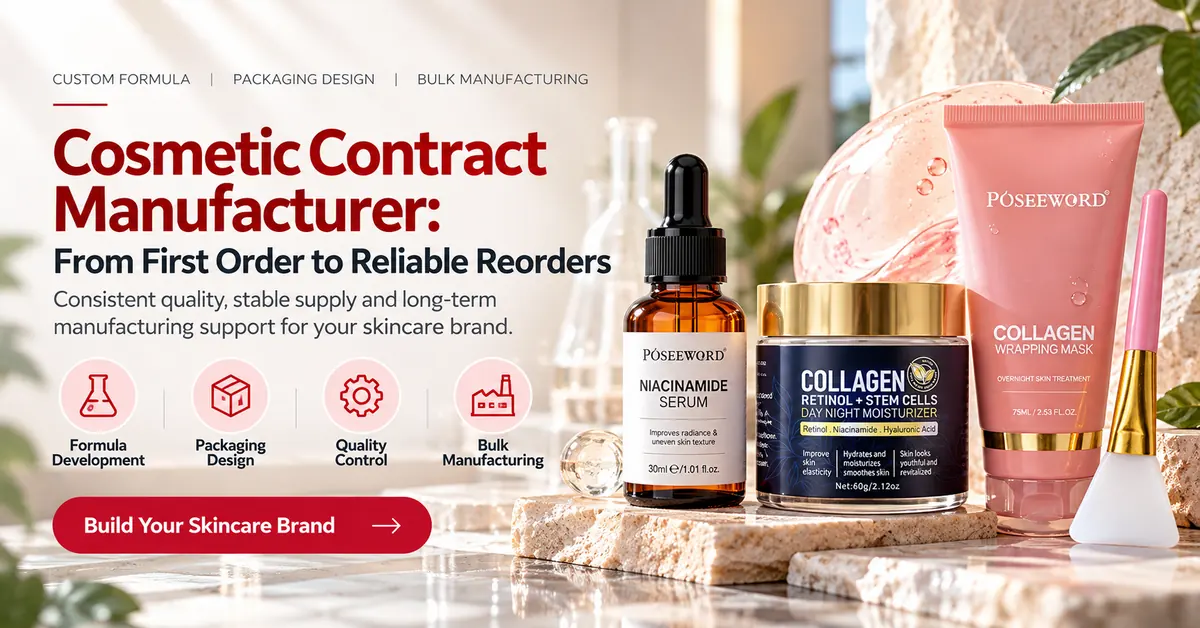
| Niacinamide Serum 30ml | Lightweight serum with niacinamide and betaine | Ingredient consistency, appearance, pH and filling | Approved formula, texture and packaging |
| TXA + Niacinamide Serum | 30ml serum listing 5% tranexamic acid and 10% niacinamide | Ingredient specifications, formulation stability, dispensing | Approved ingredient levels and formula version |
| PDRN Hyaluronic Acid Cream | Lightweight moisturizing cream, tube packaging | Emulsion consistency, viscosity and filling | Approved cream texture and tube specifications |
| Two-Piece Collagen Mask | Upper and lower facial sections, individual sachet | Mask materials, essence distribution, sealing | Approved mask structure and sachet specifications |
These are published product references. Final technical specifications, testing requirements, and acceptance limits must be agreed for each commercial project.
Essential Master Specification Fields
A professional specification should identify:
-
Product name and SKU reference.
-
Formula version and ingredient requirements.
-
Relevant appearance, pH, viscosity, or other physical characteristics.
-
Approved product net content.
-
Primary and secondary packaging specifications.
-
Product-specific testing and inspection requirements.
-
Packaging artwork revision.
-
Batch identification and traceability requirements.
-
Approved changes and revision dates.
A master specification helps reduce ambiguity when production resumes after several months or when the brand increases its purchasing volume.
7. How Should Manufacturers Manage Formula and Packaging Changes?
One of the greatest risks in long-term cosmetic manufacturing is uncontrolled change.
A manufacturer may need to replace a discontinued ingredient, source packaging from a different supplier, or adjust production parameters.
Although these changes may appear minor commercially, they can affect product stability, sensory characteristics, packaging performance, or documentation.
Recommended Manufacturing Change-Control Process
Step 1 — Identify the Change
Record the proposed change and explain why it is necessary.
Step 2 — Assess the Impact
Evaluate whether the change may affect formula performance, raw material specifications, packaging, testing, manufacturing, claims, or regulatory documentation.
Step 3 — Determine Additional Evaluation
Identify whether new samples, stability testing, compatibility testing, or production trials are appropriate.
Step 4 — Obtain Approval
Follow the agreed approval responsibilities before implementing changes that require customer authorization.
Step 5 — Update the Master Records
Revise the applicable specifications, manufacturing instructions, and approval records.
For procurement teams, this process provides a practical defense against unexpected product differences between batches.
A cosmetic contract manufacturer should be able to explain how changes are documented and communicated to customers.
8. Quality Agreements: From Incoming Materials to Batch Release
Product quality should be managed throughout the manufacturing process.
ISO 22716:2007 provides internationally recognized Good Manufacturing Practice guidelines covering the production, control, storage, and shipment of cosmetic products.
However, referencing ISO 22716 does not establish that a particular manufacturer holds an accredited certification.
For international purchasing projects, quality responsibilities should be confirmed with supporting evidence rather than inferred from promotional descriptions.
Manufacturing Quality Responsibilities
| Production Stage | Typical Controls | Recommended Documentation |
|---|---|---|
| Incoming materials | Identity, specifications and material status | Material inspection records |
| Bulk manufacturing | Processing conditions and product uniformity | Batch manufacturing records |
| In-process inspection | Applicable pH, viscosity, appearance and filling checks | In-process quality records |
| Packaging | Component conformity, sealing and label accuracy | Packaging inspection records |
| Finished-product testing | Relevant physicochemical and microbiological criteria | Finished-product test results |
| Batch release | Acceptance status and deviation review | Approved release documentation |
| Storage and shipment | Identification, handling and packaging condition | Inventory and shipping records |
The actual test program should depend on the formulation, packaging, manufacturing process, intended use, and destination market.
Huanqiutongmao's manufacturing capabilities describe raw material inspection, packaging compatibility evaluation, and semi-finished and finished-product quality checks.
Brands should determine which records are available for their specific products and identify who has authority to release each manufacturing batch.
9. How Can Brands Improve Repeat-Order Reliability?
A stable relationship with a skincare contract manufacturer requires accurate communication between sales forecasting, material procurement, manufacturing planning, and shipping.
Build a Practical Replenishment Plan
Brands should consider:
Demand Forecasting: Estimate future product requirements based on actual sales and expected promotional activity.
Packaging Availability: Confirm whether bottles, pumps, tubes, labels, and cartons can be replenished within the planned purchasing schedule.
Ingredient Availability: Identify critical ingredients that may require longer procurement periods or additional supplier verification.
Production Scheduling: Confirm manufacturing availability rather than assuming repeat orders automatically receive the same production schedule.
Quality Release: Reserve sufficient time for applicable inspections and batch approval.
Shipment Preparation: Account for packing, documentation, and agreed transportation arrangements.
A simplified reorder workflow is:
Sales Forecast → Purchase Order → Material Confirmation → Production Scheduling → Manufacturing → Quality Release → Shipment
What About MOQ and Lead Time?
Minimum order quantities and production schedules should be evaluated separately for each SKU.
A facial serum, moisturizing cream, and individually packaged mask may have different manufacturing and packaging requirements.
Buyers should request current project-specific figures instead of assuming that all cosmetic products have the same MOQ or delivery timeline.
For longer-term contracts, consider discussing forecast updates, order confirmation periods, packaging inventory arrangements, and how price changes will be communicated.
10. Understand the Full Cost of Cosmetic Contract Manufacturing
A low quoted manufacturing price does not always represent the lowest total purchasing cost.
Brands should distinguish recurring manufacturing expenses from one-time development or packaging expenses.
| Cost Component | Potential Cost Drivers | Buyer Consideration |
|---|---|---|
| Formula materials | Ingredient specifications and sourcing | Material consistency |
| Manufacturing | Batch size, equipment and processing | Unit production cost |
| Packaging | Bottles, tubes, pumps, cartons | Component minimum quantities |
| Printing | Labels, artwork and decoration | Setup and revision costs |
| Testing | Stability, compatibility and quality evaluation | Scope and responsibility |
| Development | Custom formulas and sample revisions | One-time versus recurring charges |
| Logistics | Freight, packing and delivery terms | Total landed cost |
| Inventory | Forecasting and minimum quantities | Working capital exposure |
When comparing suppliers, buyers should ask whether the quotation includes packaging, testing, labeling, documentation, and shipment-related services.
What Is the Real Cost of an Unexpected Production Change?
A packaging substitution or formula modification may trigger additional sample approval, testing, artwork changes, or production delays.
This is why controlled changes and clear contracts can be commercially valuable even when they do not directly reduce the factory's unit price.
11. How Does Contract Manufacturing Compare With OEM, ODM, and Private Label?
These service terms often overlap, and manufacturers may define them differently.
| Manufacturing Approach | Typical Responsibility | Main Commercial Consideration | Best Suited For |
|---|---|---|---|
| Contract manufacturing | Produces products under an agreed manufacturing contract | Scope, quality, supply and commercial responsibilities | Brands outsourcing manufacturing |
| OEM | Manufacturing according to agreed product requirements | Specification control and production consistency | Brands with defined products |
| ODM | Manufacturer participates in product development | Development scope and formula rights | Brands needing product-development support |
| Private label | Branding an established or adapted product | Customization limits and usage rights | Brands seeking an established starting point |
Contract manufacturing can include OEM or ODM services.
The appropriate model depends on the buyer's requirements and the responsibilities specified in the agreement.
For a brand expecting long-term repeat orders, contractual clarity, product consistency, and supply planning are often more important than the service label alone.
12. International Market Requirements and Manufacturing Responsibilities
Cosmetic manufacturing agreements should address the requirements of the destination market.
For products placed on the European Union market, Regulation (EC) No 1223/2009 establishes obligations involving cosmetic safety, product documentation, labeling, and the designated responsible person.
For the United States, applicable obligations under the Modernization of Cosmetics Regulation Act of 2022 (MoCRA) may include facility registration, product listing, and safety substantiation, subject to relevant exemptions.
The U.S. FDA does not treat cosmetic facility registration or product listing as product approval.
The brand, importer, responsible person, and manufacturer should clarify their respective documentation and regulatory responsibilities.
A manufacturer should not be assumed to handle every market-entry obligation automatically.
Practical recommendation: Before the first order, request a written list identifying which product documents the supplier can provide and which tasks remain with the brand or its appointed regulatory specialists.
13. Huanqiutongmao's Manufacturing and Development Resources
Huanqiutongmao presents its operations around cosmetic formulation research, product development, manufacturing resources, quality management, and brand planning.
Its R&D and Production page describes formulation development support, laboratory resources, stability testing, microbiological evaluation, and physicochemical testing.
The Manufacturing Capabilities section presents equipment and processes associated with cosmetic filling, vacuum emulsification, purified-water treatment, and quality inspection.
The company's Design and Planning information also describes product planning, packaging material selection, design coordination, and after-sales product feedback support.
These publicly described resources are relevant to brands evaluating customized skincare development and contract manufacturing cooperation.
Why These Capabilities Matter to B2B Buyers
Formulation support can help clarify development and product specification requirements.
Manufacturing resources are relevant when evaluating the suitability of production processes for different skincare formats.
Quality-control activities provide topics for discussing testing, packaging compatibility, and batch acceptance.
Packaging coordination helps align the intended product with its commercial presentation.
After-sales feedback support may help inform subsequent product development and optimization.
For any specific project, buyers should confirm the contracting entity, manufacturing location, available equipment, agreed services, actual order conditions, and supporting technical documents.
14. What Should You Ask Before Requesting a Contract Manufacturing Quotation?
A professional RFQ should allow the supplier to evaluate both your initial order and likely future requirements.
Cosmetic Manufacturing RFQ Checklist
| Information | Details to Provide |
|---|---|
| Product category | Serum, cream, mask, cleanser or another format |
| Formula status | Customer-owned, existing formula or new development |
| Target market | Intended countries or regions |
| Packaging | Size, container, closure, printing and labeling |
| Initial order | Estimated units per SKU |
| Reorder forecast | Expected frequency and approximate quantity |
| Quality requirements | Relevant specifications, tests and documents |
| Intellectual property | Ownership and confidentiality requirements |
| Commercial needs | Budget, delivery terms and planned schedule |
| Special concerns | Material restrictions, packaging or market requirements |
Discuss Your Manufacturing Project With Huanqiutongmao
If you are preparing to outsource skincare manufacturing, begin with a clear product brief and a realistic purchasing plan.
Huanqiutongmao offers published product references in facial serums, moisturizers, facial masks, and other beauty product categories.
You can review the cosmetic product portfolio and explore its OEM/ODM service information.
When contacting the team, include your intended product category, formula requirements, target market, packaging preferences, initial volume, and expected repeat-order needs.
This information creates a stronger starting point for discussing technical feasibility, customization, documentation, and commercial terms.
15. Frequently Asked Questions About Cosmetic Contract Manufacturing
1. What is a cosmetic contract manufacturer?
A cosmetic contract manufacturer produces cosmetic products for another business under agreed manufacturing and commercial terms. Services may cover formulation, sourcing, bulk production, filling, packaging, inspection, and documentation, depending on the contractual scope.
2. How do I choose a cosmetic contract manufacturer for long-term supply?
Evaluate product-category experience, manufacturing capabilities, quality management, documentation, change-control procedures, communication, and production planning. Ask how the supplier manages repeat orders rather than evaluating only its initial samples and quotations.
3. Can I use my own cosmetic formula with a contract manufacturer?
Potentially, yes. The manufacturer must assess whether the formula is technically suitable for its production equipment, available materials, processing conditions, and quality requirements. Formula transfer and confidentiality terms should be established in advance.
4. Who owns a formula developed by a cosmetic manufacturer?
Formula ownership depends on the development and intellectual property agreement. Paying for development does not automatically establish exclusive ownership. Brands should negotiate formula rights, confidentiality, and transfer permissions before development begins.
5. What is the MOQ for cosmetic contract manufacturing?
MOQ varies according to formula requirements, production batch size, packaging components, and customization. Buyers should request a project-specific quotation and distinguish finished-product MOQ from packaging-material minimums.
6. How can a brand maintain consistent quality across repeat orders?
Maintain approved specifications, control ingredient and packaging changes, document manufacturing processes, apply relevant quality inspections, and establish clear batch-release responsibilities. Reorders should be evaluated against the approved product reference.
7. Can a manufacturer change raw material suppliers without notifying the brand?
This depends on the agreement and applicable requirements. Buyers should establish a change-control procedure identifying which supplier, ingredient, packaging, or process changes require notification, testing, and prior approval.
8. What is the difference between a manufacturing agreement and a quality agreement?
A manufacturing agreement generally addresses commercial obligations, product scope, ownership, purchasing, and delivery. A quality agreement defines operational responsibilities involving specifications, testing, deviations, records, and batch release. The two documents may complement each other.
9. Can one manufacturer produce serums, creams, and facial masks?
Some manufacturers support multiple cosmetic formats, but the required equipment and processing controls differ. Buyers should verify manufacturing suitability and quality capabilities for each intended product category.
10. How can I request contract manufacturing services from Huanqiutongmao?
Prepare a brief describing your products, target market, formulation preferences, packaging requirements, initial order quantity, and repeat-order forecast. Then explore the company's skincare product range and contact Huanqiutongmao through its official website to discuss available development and manufacturing arrangements.
Conclusion
Choosing a cosmetic contract manufacturer is ultimately a decision about long-term product quality, manufacturing accountability, and supply continuity.
A successful first order establishes an approved product. A successful manufacturing partnership creates the documentation, quality controls, commercial agreements, and communication procedures needed to reproduce that product consistently.
For skincare brands, the essential priorities include clear formula ownership, master product specifications, documented changes, appropriate quality inspections, realistic production planning, and transparent reorder terms.
Huanqiutongmao's published formulation, manufacturing, packaging, and quality-management resources provide a starting point for international beauty brands evaluating outsourced skincare production.
Looking for a manufacturing partner for your skincare brand? Explore Huanqiutongmao's cosmetic products and OEM/ODM services, then share your project requirements to discuss suitable manufacturing options and long-term supply planning.