Choosing a cosmetics OEM factory is not simply about finding a supplier that can reproduce an attractive product sample. The real challenge is ensuring that an approved formulation can be manufactured consistently, filled into compatible packaging, inspected against agreed specifications, and delivered according to the brand's commercial requirements.
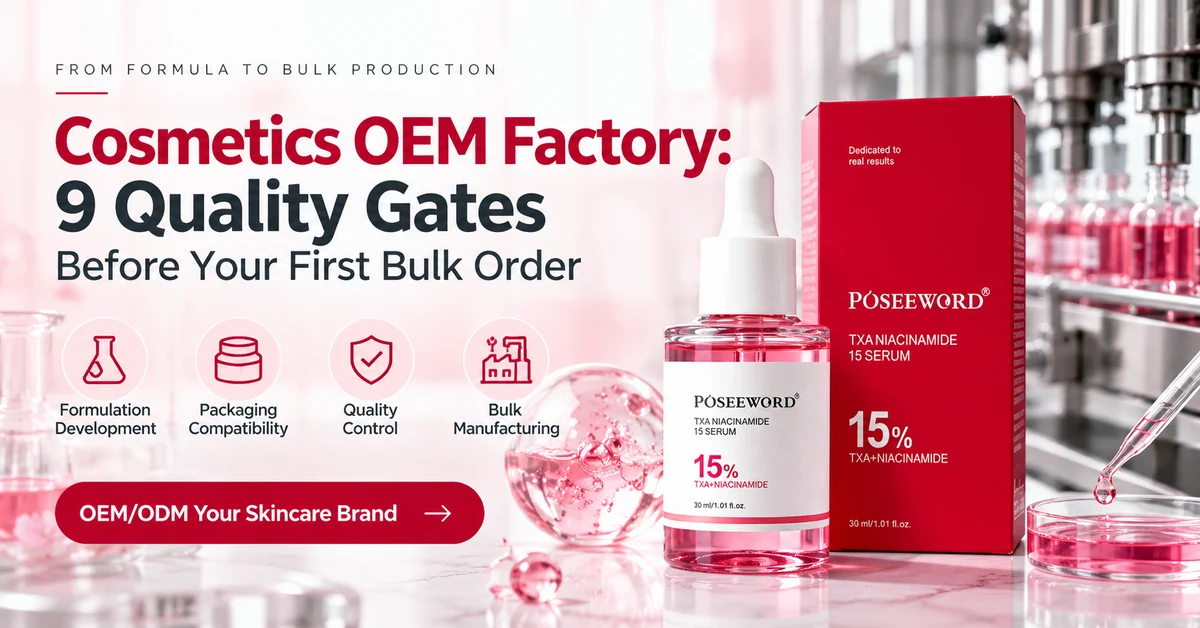
Before approving bulk production, beauty brands should verify nine essential areas: product specifications, raw materials, formula scale-up, packaging compatibility, stability and safety evaluation, production planning, final artwork approval, in-process quality control, and finished-batch release.
These checkpoints matter for skincare startups, established cosmetic brands, wholesalers, and international importers alike.
A successful first production order should establish more than inventory. It should create a documented manufacturing reference that supports consistent replenishment and future product development.
1. What Should a Cosmetics OEM Factory Verify Before Bulk Production?
A reliable cosmetic manufacturing process should connect every production decision to documented specifications and clear approval responsibilities.
The following nine-gate framework provides a practical starting point for brand owners and procurement teams.
| Production Gate | Critical Verification | Evidence to Request |
|---|---|---|
| 1. Product brief | Product positioning, intended market, specifications | Approved product development brief |
| 2. Formula and materials | Ingredient identity, formula version, material quality | Formula reference and material specifications |
| 3. Scale-up feasibility | Laboratory formula compatibility with production equipment | Pilot-batch or manufacturing evaluation records |
| 4. Packaging compatibility | Container, closure, dispensing and formula interactions | Packaging approval and compatibility results |
| 5. Stability and safety | Relevant physical, chemical and microbiological risks | Applicable testing records and assessments |
| 6. Production planning | MOQ, material availability, capacity and delivery schedule | Written quotation and production plan |
| 7. Final sample approval | Appearance, packaging artwork, label and product presentation | Approved master sample and artwork |
| 8. Manufacturing QC | Batch processing, filling, sealing and in-process inspection | Production and inspection records |
| 9. Finished-batch release | Finished goods quality, traceability and shipment readiness | Batch-release documentation |
These are recommended buyer approval gates, not a claim that every manufacturer uses an identical nine-stage system.
For buyers evaluating production resources, Huanqiutongmao's manufacturing capabilities provide an overview of cosmetic production equipment, filling systems, workshops, and quality-control activities.
2. Which Buyers Need This OEM Production Checklist?
Different businesses encounter different manufacturing risks.
Emerging skincare brands often need support with product specifications, formula selection, sample approval, packaging costs, and initial order quantities. Their biggest challenge may be entering production without committing to excessive inventory.
Established beauty brands commonly require stronger controls over formula consistency, ingredient sourcing, packaging specifications, multiple SKUs, and repeat manufacturing.
Cosmetic importers and distributors must coordinate supplier documentation, retail packaging, target-market requirements, inventory scheduling, and product traceability.
Product development and procurement managers need measurable acceptance criteria so that the production team, quality team, and brand agree on what constitutes an acceptable finished product.
This framework is less relevant to buyers seeking only individual ready-to-ship retail products without manufacturing or customization requirements.
The central question is not whether a supplier can manufacture cosmetics in general. It is whether the proposed manufacturing arrangement is appropriate for the specific product, market, order volume, and required documentation.
3. Gate One: Define the Product Before Requesting a Bulk Quotation
A vague product request creates uncertainty throughout manufacturing.
For example, asking for a "premium brightening serum" does not tell a factory enough about the required formulation, texture, target consumer, packaging, or intended market.
A useful OEM product brief should specify:
-
Product category and intended use.
-
Target consumer and sales channels.
-
Preferred ingredients and any ingredient restrictions.
-
Desired texture, color, fragrance, and sensory properties.
-
Target net content and packaging format.
-
Intended sales markets and proposed product claims.
-
Expected initial quantity and replenishment needs.
-
Target price range and launch milestones.
These details help the factory evaluate technical feasibility before major sampling or packaging expenses occur.
Practical recommendation: Approve a written product brief before proceeding to formula development. Any later changes should be documented because they may affect testing, packaging, cost, and production timing.
4. Gate Two: Establish Formula and Raw Material Control
The consistency of cosmetic products depends on accurately defined ingredients and a controlled formula.
Two products marketed with the same headline ingredient may differ substantially in ingredient concentrations, supporting materials, viscosity, texture, stability, and packaging requirements.
For example, the POSEEWORD TXA + Niacinamide Serum is publicly described as a 30ml serum containing 5% tranexamic acid and 10% niacinamide.
Those declared concentrations are useful reference information, but they do not independently establish the complete formula, finished-product safety, or suitability for every market.
Before production, buyers should confirm:
-
The approved formula identification and revision number.
-
The ingredient list and relevant raw material specifications.
-
Critical ingredient sourcing and substitution controls.
-
Agreed product appearance and sensory characteristics.
-
Any necessary material documentation and inspection requirements.
Where proprietary formulations are involved, formula ownership, confidentiality, and permitted modifications should be addressed contractually.
A cosmetics OEM factory should also have a clear process for reviewing material changes that could affect finished-product consistency.
5. Gate Three: Confirm the Formula Can Be Manufactured at Scale
A successful laboratory sample does not automatically guarantee identical performance during commercial manufacturing.
Larger production batches may require different mixing conditions, temperature management, processing times, and equipment settings.
For emulsions, manufacturing controls may include ingredient addition sequence, heating and cooling conditions, mixing intensity, and homogenization.
For water-based serums, considerations may include ingredient dissolution, pH adjustment, viscosity, appearance, and filling compatibility.
Why pilot-scale evaluation matters
Depending on the formulation and commercial risk, a pilot or engineering batch can help determine whether laboratory results translate into manufacturing conditions.
Key questions include:
-
Does the production process maintain the intended texture?
-
Can the equipment process the proposed batch size?
-
Are the mixing and transfer steps appropriate?
-
Are there noticeable differences between laboratory and production samples?
-
Which in-process parameters require monitoring?
Huanqiutongmao's R&D and Production page describes customized formula development, physicochemical evaluation, stability testing, and laboratory resources.
Brands should confirm which scale-up records and approval samples can be provided for their specific projects rather than assuming every product follows the same validation procedure.
6. Gate Four: Test the Final Formula With Its Packaging
Packaging should be evaluated as part of the complete cosmetic product, not merely as a decorative container.
A serum may require a dropper bottle or pump. A moisturizer may use a jar or tube. A face mask may need an individually sealed sachet.
Each combination introduces different compatibility and manufacturing considerations.
Product-Specific Manufacturing Requirements
| Cosmetic Product | Product Format | Key Production Considerations | Packaging Checks |
|---|---|---|---|
| Niacinamide Serum 30ml | Lightweight facial serum | Formula homogeneity, pH, viscosity, filling consistency | Container compatibility, closure and dispensing |
| Retinol Collagen Moisturizer | 60g cream in a cosmetic jar | Emulsion stability, texture, ingredient stability | Jar sealing, product protection, filling accuracy |
| Two-Piece Collagen Mask | Two facial pieces with essence | Mask dimensions, essence distribution, microbial quality | Sachet sealing and leakage resistance |
| Collagen Peel-Off Mask | Gel-type peel-off mask | Viscosity, film formation, dispensing behavior | Tube compatibility and closure performance |
| Camellia Cleansing Oil Capsules | Single-use oil capsules | Oil formulation consistency and dose control | Capsule integrity, leakage and material compatibility |
The products above are examples from the published catalog. Testing requirements and acceptance limits must be determined for the final approved formulations and packaging.
Huanqiutongmao's manufacturing information describes evaluations involving packaging appearance, sealing performance, pressure resistance, and compatibility.
Buyer takeaway: Do not approve a product solely in a laboratory container. Evaluate the intended commercial formula and final packaging combination before committing to bulk manufacturing.
7. Gate Five: Review Stability, Safety, and Quality Evidence
Quality testing should be appropriate to the product's formulation, packaging, intended use, and destination market.
For a cosmetics OEM factory, the objective is to identify relevant risks before a large quantity of finished products is produced.
Important evaluation areas may include:
Physical and chemical stability: Appearance, pH, viscosity, separation, color, odor, and other product-specific characteristics.
Microbiological quality: Relevant microbial specifications, preservation effectiveness where necessary, and appropriate production hygiene controls.
Packaging performance: Leakage, material compatibility, seal integrity, dispensing functionality, and storage-related changes.
Product safety and claims: Ingredient assessment, intended use, available supporting evidence, and market-specific claim requirements.
Which manufacturing standards matter?
ISO 22716:2007 provides internationally recognized guidelines for cosmetic Good Manufacturing Practices covering production, control, storage, and shipment.
However, referring to ISO 22716 does not prove that a specific factory has been independently certified.
For EU products, Regulation (EC) No 1223/2009 provides the main cosmetics framework, including safety assessment and product documentation obligations.
For U.S. products, the Modernization of Cosmetics Regulation Act of 2022 introduces obligations that may include facility registration, product listing, and safety substantiation, subject to applicable requirements and exemptions. FDA registration is not the same as FDA approval.
Before placing an order, clarify which documentation the manufacturing partner can supply and which responsibilities remain with the brand, importer, or designated responsible person.
8. Gate Six: Confirm MOQ, Capacity, Material Availability, and Production Timing
The minimum order quantity for cosmetic manufacturing is rarely determined by a single factor.
A realistic project may involve separate quantities for bulk formulation, bottles or jars, printed labels, retail cartons, and finished-product packing.
What affects cosmetics OEM manufacturing costs?
| Cost Factor | Potential Impact | Buyer Recommendation |
|---|---|---|
| Formula complexity | Ingredient and processing costs | Confirm approved formula specifications |
| Active ingredients | Raw material availability and pricing | Review ingredient requirements and sourcing |
| Packaging | Component costs and order minimums | Compare stock and custom packaging |
| Printing and decoration | Setup fees and artwork preparation | Finalize branding requirements early |
| Testing | Project-specific testing expenses | Agree on necessary tests and responsibilities |
| Order quantity | Unit economics and inventory exposure | Compare realistic production scenarios |
| Logistics | Freight, packing and delivery costs | Confirm shipping terms and destination |
The quoted price should clearly identify what is included and excluded.
How should buyers evaluate lead time?
Instead of requesting only a total delivery estimate, break the project into stages:
Formula Confirmation → Sample Approval → Packaging Procurement → Testing → Production Scheduling → Bulk Manufacturing → Quality Inspection → Shipment Preparation
Each stage can influence the final delivery date.
Brands should request a project-specific schedule rather than rely on generic promises of fast production.
Where necessary, confirm the actual manufacturing entity, available production line, order scheduling arrangements, and capacity for future replenishment.
9. Gate Seven: Approve Artwork, Labels, and the Master Sample
An approved laboratory formula is not the final commercial product.
Before manufacturing begins, the brand should review the finished presentation, including:
-
Product name and approved label wording.
-
Final ingredient declaration.
-
Net content and required packaging information.
-
Product claims and usage instructions.
-
Printed artwork and color references.
-
Primary packaging and outer carton specifications.
-
Approved commercial product sample.
Label information must be reviewed against the requirements of the intended sales market.
A signed or otherwise documented master sample provides a practical visual and physical reference for manufacturing and final inspection.
This can reduce disagreements over differences in appearance, packaging, printing, or product texture.
Huanqiutongmao also describes product planning, packaging material selection, and brand design support on its Design and Planning page.
10. Gate Eight: Monitor the First Commercial Production Batch
Once all essential requirements are approved, manufacturing can proceed according to the agreed production instructions.
Critical controls may include equipment preparation, material identification, processing parameters, filling quantities, sealing performance, labeling, and packaging inspection.
Recommended In-Process Quality Checks
| Production Stage | Typical Verification |
|---|---|
| Material preparation | Material identity, batch information, approved status |
| Mixing or emulsification | Process parameters, appearance, homogeneity |
| Intermediate inspection | Relevant pH, viscosity and physical characteristics |
| Filling | Fill quantity and container handling |
| Sealing | Closure performance, leakage and seal condition |
| Packaging | Label accuracy, print appearance, component integrity |
| Batch documentation | Production records, deviations and traceability |
The precise checks and acceptance limits depend on the product and approved quality plan.
Huanqiutongmao publicly describes raw material inspection, semi-finished product inspection, finished-product testing, and packaging compatibility evaluation.
Its manufacturing quality approach emphasizes controlling nonconforming materials and products throughout production rather than relying exclusively on final inspection.
For first-time customers, it is particularly useful to agree on how deviations are reported, investigated, and resolved before products are released.
11. Gate Nine: Approve Finished-Batch Release and Shipment
The last production gate should confirm that the completed order corresponds to the approved requirements.
Buyers should determine which records will accompany or support each commercial batch.
Depending on the product and agreement, these may include:
-
Finished-product inspection results.
-
Batch identification and traceability information.
-
Applicable Certificate of Analysis or test documentation.
-
Approved packaging and labeling records.
-
Quantity confirmation and packing information.
-
Records of deviations and corrective actions, where relevant.
-
Shipment documentation and agreed delivery arrangements.
The availability and scope of documents should be confirmed before the purchase order is finalized.
A finished batch should not be considered ready merely because filling and packaging are complete. Quality approval, documentation, and commercial release responsibilities should also be clear.
12. OEM, ODM, or Existing-Formula Production: Which Route Is Appropriate?
The right manufacturing arrangement depends on how much development responsibility the buyer wants to retain.
| Manufacturing Route | Product Development Approach | Main Approval Priority | Suitable Buyer |
|---|---|---|---|
| Existing-formula private label | Uses an established formula with agreed branding or limited changes | Packaging, branding, product suitability | Brands seeking a simpler development process |
| Cosmetics OEM | Factory manufactures to agreed product specifications | Formula transfer, process control, batch consistency | Brands with clearly defined product requirements |
| Cosmetics ODM | Manufacturing partner participates in product development | Formula approval, testing, design and production readiness | Brands requiring broader development support |
These terms can vary among suppliers. The actual contract should specify formula responsibilities, intellectual property arrangements, testing scope, customization, and deliverables.
For a new skincare brand, using an established formulation may reduce development complexity. A brand pursuing a differentiated product may require additional formulation work and technical evaluation.
Neither approach eliminates the need for quality and packaging approval.
13. How Huanqiutongmao Supports Cosmetic Manufacturing Projects
Huanqiutongmao presents its business around cosmetic research, product development, manufacturing resources, quality management, and brand planning.
Its published capabilities include:
-
Formulation development: R&D resources and customized skincare formulation support.
-
Manufacturing equipment: Automated production, filling equipment, vacuum emulsifying equipment, and purified-water treatment resources.
-
Product evaluation: Stability, sensitivity, efficacy, microbiological, and physicochemical testing programs.
-
Packaging support: Packaging material selection and design coordination.
-
Quality management: Inspection activities covering materials, production stages, finished products, and packaging.
-
Product planning: Assistance with product-line development and brand presentation.
These capabilities provide useful starting points for brands exploring cosmetic manufacturing cooperation. Specific equipment availability, certification status, project scope, production location, MOQ, and delivery commitments should be confirmed for each order.
You can explore the cosmetic product portfolio or review the company's OEM/ODM services.
Request a Project-Specific OEM Manufacturing Review
If you are developing a facial serum, moisturizer, facial mask, cleansing product, or another cosmetic SKU, prepare a project brief containing:
Product type + target market + preferred formula + packaging requirements + estimated quantity + launch schedule.
Share these details with the Huanqiutongmao team through the contact information on the official website.
A precise project brief allows for a more useful discussion of formulation feasibility, sampling, testing, packaging, production arrangements, and quotation requirements.
14. Frequently Asked Questions About Cosmetics OEM Factories
1. What is a cosmetics OEM factory?
A cosmetics OEM factory manufactures cosmetic products according to specifications agreed with a brand or business customer. Depending on the arrangement, the manufacturer may support formulation, materials, packaging, filling, inspection, and production documentation.
2. How is cosmetics OEM different from private label manufacturing?
OEM generally emphasizes manufacturing to agreed product requirements. Private label often starts with an existing formula or product adapted for the buyer's branding. However, service definitions vary, so the actual customization and ownership arrangements should be confirmed.
3. What is the minimum order quantity for cosmetics OEM production?
MOQ depends on the formulation, manufacturing batch requirements, packaging components, printing, and other project conditions. A factory should provide a project-specific minimum quantity rather than an unsupported universal figure.
4. Can a cosmetics OEM factory customize active ingredients?
Many cosmetic development programs allow ingredient adjustments, but feasibility depends on the full formulation, stability, safety, intended claims, and destination market. Every significant modification should be evaluated before production.
5. How long does cosmetic OEM manufacturing take?
The schedule depends on formulation development, sampling revisions, testing, packaging procurement, production capacity, and order complexity. Buyers should request a timeline that separates development and manufacturing stages.
6. Why is cosmetic packaging compatibility testing important?
Packaging can affect product protection, leakage resistance, dispensing, stability, and consumer experience. Testing helps determine whether the approved formulation and final packaging work together under relevant conditions.
7. What quality-control documents should a cosmetics factory provide?
Applicable documents may include material specifications, batch records, inspection reports, test results, and finished-product release records. Required documents vary by product, market, and commercial agreement.
8. Does ISO 22716 mean a cosmetics factory is certified?
No. ISO 22716 is a cosmetics GMP guideline. A statement that a factory follows or references the standard does not independently establish certification. Buyers should request relevant evidence and verify the certification scope, issuing body, and validity if certification is claimed.
9. Can one cosmetics OEM factory produce different skincare products?
Some manufacturing operations support multiple cosmetic categories, but technical suitability must be evaluated separately. Serums, emulsions, face masks, creams, and oil-based products may require different equipment, packaging, process controls, or inspection methods.
10. What information should I provide before requesting a cosmetics OEM quotation?
Provide the product category, target market, formula preferences, expected packaging, estimated order volume, desired customization, testing requirements, and planned launch schedule. These details help the supplier evaluate feasibility and prepare a more relevant quotation.
Conclusion
Selecting a cosmetics OEM factory should be based on more than product samples, promotional claims, or an attractive unit price. For beauty brands and international buyers, the most valuable manufacturing partner is one that can help translate approved product requirements into a controlled, repeatable, and commercially practical production process.
The nine production gates outlined in this guide provide a structured way to assess formula readiness, material control, scale-up feasibility, packaging compatibility, testing, production planning, manufacturing quality, and final-batch release.
Huanqiutongmao offers published resources covering skincare formulation development, cosmetic manufacturing, product evaluation, packaging coordination, and quality management. Brands planning their first OEM order or expanding an existing product portfolio can explore its products and manufacturing solutions and discuss project-specific requirements through the Huanqiutongmao website.
Start with a clear product specification, verify the critical manufacturing checkpoints, and build a production plan designed to support both your first order and long-term brand growth.