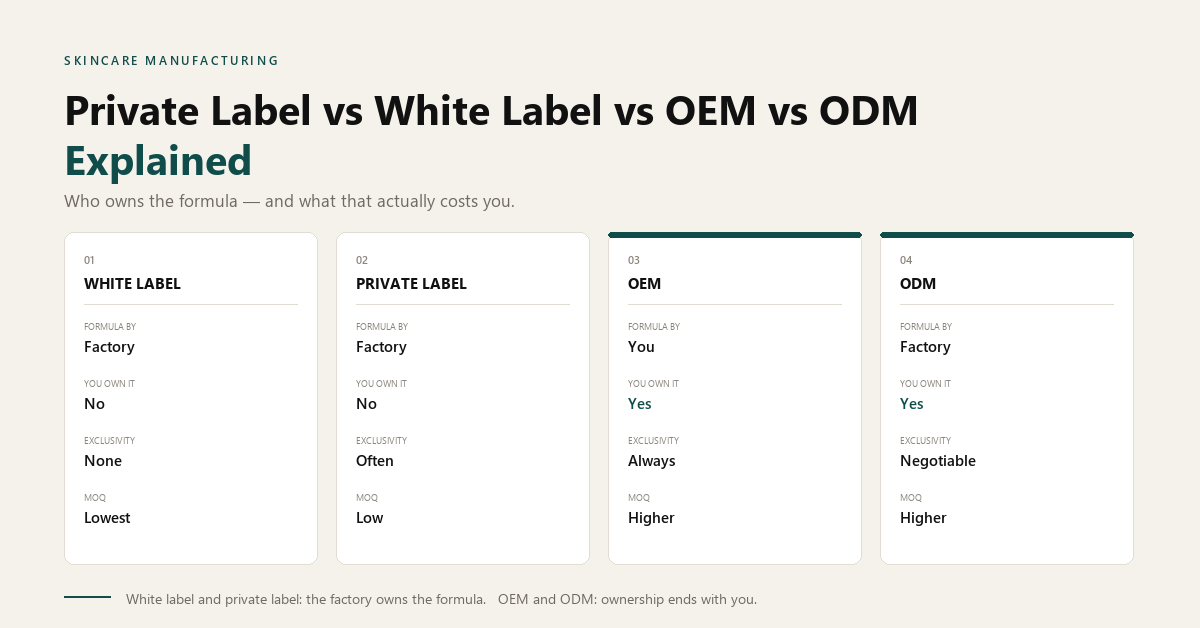
Four terms get used interchangeably in almost every supplier conversation — and they describe four completely different business arrangements. Choosing the wrong one costs either money or control, and most first-time brand owners only find out after the purchase order is signed.
Here's the honest breakdown, from the factory side of the table.
The short version
|
Model |
Who creates the formula |
Who owns it |
Exclusivity |
Typical MOQ |
Time to first order |
|
White Label |
Factory |
Factory |
None |
Lowest |
[1–3] weeks |
|
Private Label |
Factory |
Factory (you license it) |
Often available |
Low |
[3–6] weeks |
|
OEM |
You |
You |
Always yours |
Higher |
[6–10] weeks |
|
ODM |
Factory, for you |
Transfers to you |
Negotiable |
Higher |
[8–16] weeks |
If you remember nothing else: white label and private label mean the factory owns the formula; OEM and ODM mean you end up owning it.
1. White Label — the same product, many brands
A white label product is a finished formula that the factory already makes and sells to anyone who orders it. You add your logo, your carton, your label — and you're in business.
What it's good for: testing a market fast, launching a first SKU on a small budget, filling a gap in an existing line.
What it costs you: differentiation. If five other brands are selling the same white label serum, your only competitive levers are price and marketing. There's no exclusivity and no protection — the factory can sell the identical product to your competitor next week.
A detail suppliers rarely mention: white label often means the bulk is identical, but the fill weight, fragrance level and packaging can still be adjusted. Ask what's actually adjustable before assuming you're getting a copy-paste product.
2. Private Label — the factory's formula, your brand
Private label sits one step up. The factory still owns the formula, but it's produced for you under your brand, often with adjustments — a different active level, a modified texture, a different fragrance.
The line between white label and private label is genuinely blurry, and the industry doesn't help. The practical distinction most factories use:
White label
● = off-the-shelf, sold to many, no changes
Private label
● = from the factory's catalog, customized and branded for you, sometimes with category exclusivity
What it's good for: launching a branded line without paying for formulation, getting to market in weeks rather than months.
What it costs you: the formula still isn't yours. If you sell the business, or if you want to move to a second manufacturer later, you can't take the formula with you. You're renting the product, not owning it.
3. OEM — you bring the formula, we build it
OEM (Original Equipment Manufacturer) means you arrive with the formula or a reference sample, and the factory manufactures to your specification.
What it's good for: brands with an in-house chemist, a formula acquired from a lab, or a proven product they're scaling from another supplier.
What it costs you: you carry the formulation risk. If the formula doesn't survive scale-up — and many bench formulas don't — the cost of fixing it lands on you.
The scale-up problem nobody warns you about: a 500 g lab batch and a 3,000 L production batch behave differently. Emulsion stability, homogenization shear and cooling rates all change with volume. A factory doing proper OEM work will run a pilot batch and flag the adjustments before committing to bulk. If yours goes straight from sample to production, that's a warning sign.
4. ODM — the factory designs it, for you alone
ODM (Original Design Manufacturer) is the reverse: you bring the brief — market, price point, texture, claims — and the factory's R&D team develops the formula.
What it's good for: brands with a clear positioning but no formulation capability. This is the most common model for new skincare brands launching a differentiated line.
What it costs you: development fee and time. Typically [X] per project and [70–120] days from brief to first shipment, because stability testing can't be rushed.
The ownership question is the whole game here. In a well-structured ODM agreement, full formula ownership — the formula itself, the manufacturing process and the technical dossier — transfers to you on final payment. In a badly structured one, you pay for development and still don't own anything. Get this in writing before the first sample.
The naming problem: OEM means different things in different countries
This trips up almost every buyer sourcing from Asia.
In China's cosmetics industry, OEM usually means "factory manufactures to your formula" and ODM means "factory develops the formula for you" — as described above.
But in Western usage, OEM often refers to manufacturing a product that will be sold under the buyer's brand — which overlaps heavily with what China calls private label. Some European suppliers use "OEM" to mean contract manufacturing of any kind.
Practical advice: don't rely on the label. Ask three questions instead:
1. Who writes the formula — you or me?
2. Who owns the formula after I pay?
3. Can you sell this same formula to another brand?
The answers tell you which model you're actually buying, regardless of what it's called on the quotation.
Who is legally responsible — and it's probably you
This is the part new brand owners most often get wrong.
Under the US MoCRA framework and the EU Cosmetics Regulation, the party legally responsible for a cosmetic product is the brand — the "Responsible Person" — not the factory. That holds true even in a pure white label arrangement where you had no hand in the formula at all.
In practice that means, regardless of which of the four models you choose:
● Safety substantiation must exist and be held on file
● Product listing / notification obligations sit with you
● Labeling compliance — INCI, net content, warnings, responsible person address — is your legal exposure, not the factory's
● Adverse event reporting is your obligation
A good manufacturer supplies the documentation to support all of this — COA, MSDS, INCI declaration, stability data, micro testing. But supplying documents is not the same as carrying responsibility. Ask any prospective supplier which documents they provide per batch, and confirm they'll support a CPSR or safety assessment.
Which model should you choose?
You're testing a concept with limited capital → white label. Minimum spend, fastest launch, and you learn what sells before committing to formulation.
You want a branded line but not a chemistry project → private label. Catalog formulas, your packaging, weeks not months.
You have a formula or a proven product → OEM. You keep control of the formula; the factory's job is to reproduce it at scale.
You have a positioning but no formula → ODM. Highest upfront cost, but you end up owning a product nobody else can sell.
A common path: start white label to validate demand, move to private label once a SKU proves itself, then commission ODM for the hero product that defines the brand. There's no rule that says you pick one and stay there.
Four questions to ask before you sign
Who owns the formula?
1. Get it in the contract, not in an email.
Is there category exclusivity?
2. And for how long, in which markets?
What changes between sample and bulk?
3. Ask specifically about pilot batches.
Which compliance documents come with each shipment?
4. COA, MSDS, INCI, stability, micro, and a Certificate of Free Sale where applicable.
The answers separate a supplier from a partner faster than any factory tour.