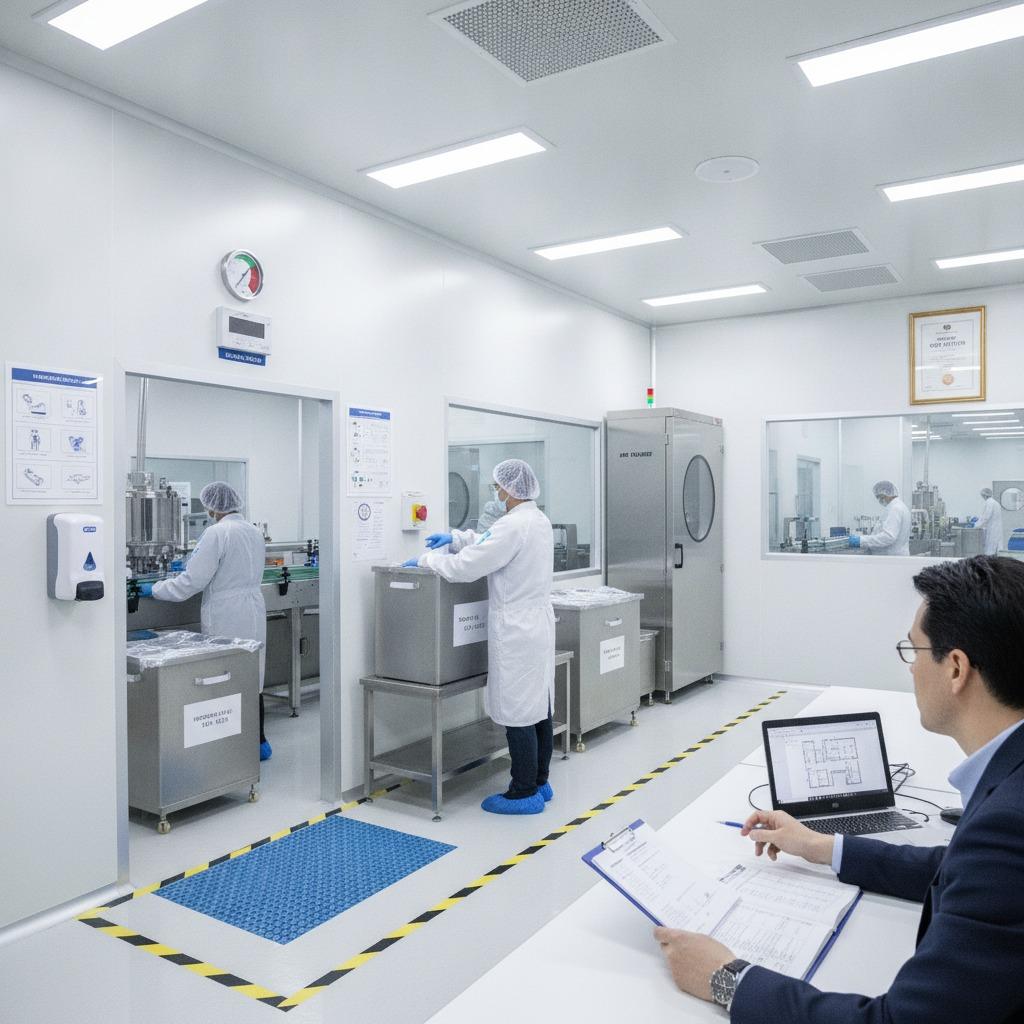
When vetting an overseas skincare contract manufacturer, procurement managers frequently encounter promotional banners touting a certified GMP车间 (Good Manufacturing Practice workshop) alongside sweeping claims of massive factory square footage. In private-label skincare—especially high-risk, moisture-rich categories like crystal gel and sheet masks—the cleanroom envelope is not just a marketing badge. It is your primary defense against microbial contamination, formulation instability, and disastrous product recalls. Yet, there is often a vast disconnect between the cleanroom photos shown on wholesale platforms and the operational rigor required to sustain repeatable cosmetic quality.
Decoding the Facility Floor: Beyond Brochure Photography
Suppliers routinely showcase polished facility images to build buyer confidence. When evaluating an OEM partner specialized in topical formulations, a credible 化妆品GMP车间 must exhibit clear physical segregation between distinct operational stages. A promotional snapshot might show clean floors, but an experienced sourcing engineer looks at workflow zoning:
- Formulation & R&D Workstations: Bench-scale labs should feature dedicated fume extraction, proper reagent storage, and separate analytical staging to prevent pre-production cross-contamination before batch scaling even begins.
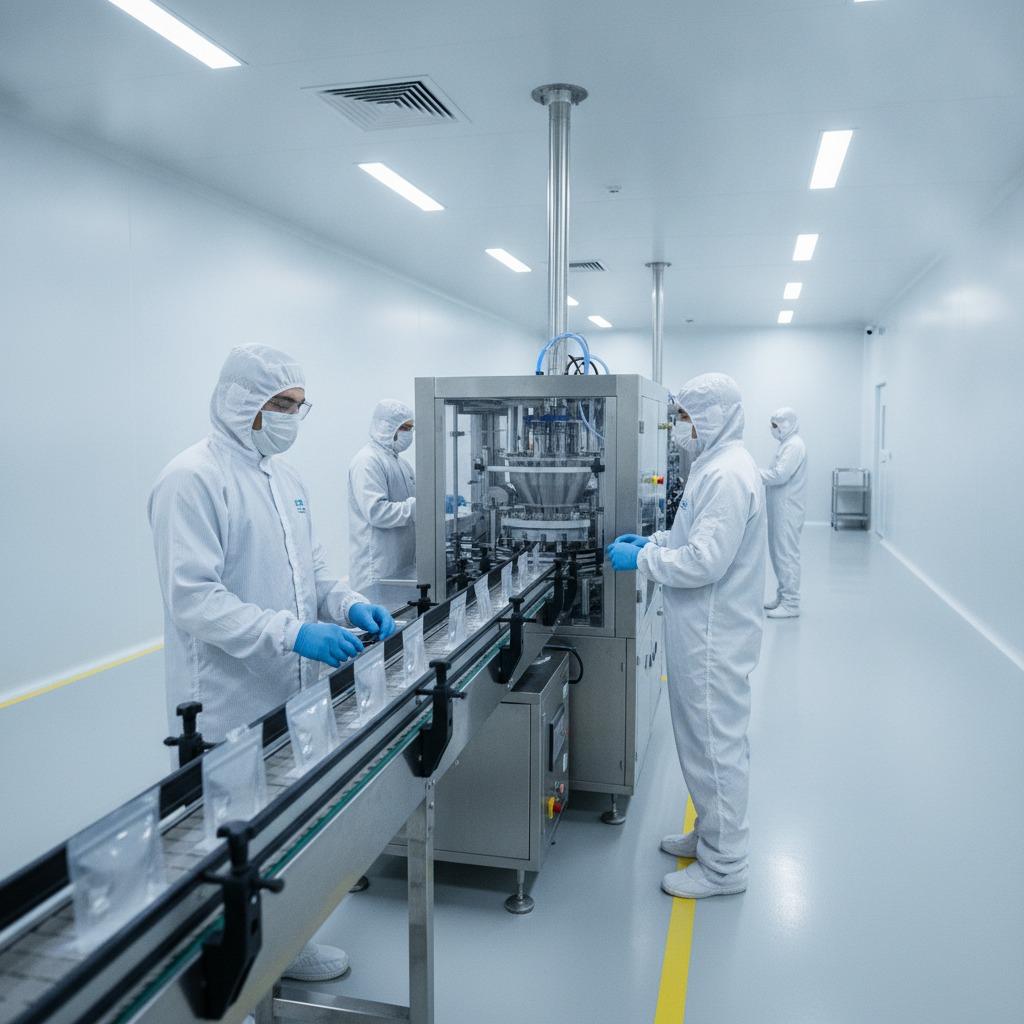
- Automated Transfer & Filling Lines: Modular conveyor systems constructed from cleanroom-grade stainless steel and anodized aluminum frames, fitted with physical safety shields, represent the minimum baseline for automated essence dosing and pouch filling.
- Enclosed Primary Sealing Machinery: High-speed form-fill-seal units, complete with integrated film feeds and programmable logic controllers (PLCs), keep open product exposure to an absolute minimum during thermal sealing.
- Secondary Packaging Stations: Even outside the sterile filling envelope, manual packing lines require operators in full protective gear—cleanroom gowns, hairnets, procedural masks, and nitrile gloves—handling finished cartons and transit bins under controlled airflow.
Understanding the GMP车间标准: Class 100,000 in Practice
Many cosmetics facilities market their cleanrooms as "十万级" (Class 100,000, roughly equivalent to ISO Class 8 under ISO 14644-1). While this is the recognized industry baseline for topical skincare manufacturing, holding your supplier to a defined GMP车间标准 involves far more than simply running industrial HVAC systems.
An ISO Class 8 environment permits up to 3,520,000 particles (≥ 0.5 µm) per cubic meter of air. For water-dense formulations such as crystal hydrogel masks, airborne microbial counts are just as critical as non-viable particulate counts. A compliant workshop must maintain positive pressure cascades—ensuring air moves outward from sensitive filling zones into secondary corridors—coupled with routine HEPA filter integrity testing, controlled humidity, and disciplined changeover sanitization protocols between production batches.
A frequent trap for foreign buyers is conflating the gross site footprint with actual controlled cleanroom space. A supplier may claim a "100,000-square-meter production base," yet the actual climate-controlled cleanroom suite might occupy only a modest fraction of that footprint. Always request a validated facility architectural layout specifying the exact square meterage of the classified clean zones versus ambient warehousing.
Verifying GMP车间认证: What Due Diligence Demands
Supplier profiles often display glossy certificates, but a genuine GMP车间认证 requires third-party validation that matches the manufacturing entity's legal business license. For international cosmetics sourcing, ISO 22716 (Cosmetics GMP) or regional equivalents like US FDA cGMP compliance audits serve as the gold standard.
Rather than accepting a low-resolution certificate scan, ask the prospective factory for the full third-party audit report. Review the auditor's non-conformance log, the facility's corrective and preventive action (CAPA) history, and the water treatment monitoring logs. In water-heavy product lines, an unmonitored deionized or reverse osmosis (RO) water loop will ruin a production run regardless of how clean the air handling system claims to be.
The On-Site Audit: What to Inspect When You Walk the Floor
Reputable contract manufacturers openly state that they support on-site factory inspections. If you or your designated third-party inspection agency conduct a walk-through, focus your attention on the operational seams where human handling intersects automated processing:
- Personnel Airlocks and Gowning Discipline: Observe shift handovers. Are workers crossing gowning benches properly without tracking floor particulates into the production corridor? Are mask-wearing protocols strictly enforced?
- Material Transfer Air Showers: Check whether raw materials and intermediate packaging enter through interlocked pass-through boxes or dynamic airlocks rather than propped-open emergency exit doors.
- Equipment Clean-in-Place (CIP) Execution: Inspect how mixing vessels, product lines, and automated filling nozzles are flushed and swabbed between different product formulation cycles.
Frequently Asked Questions
Does a Class 100,000 cleanroom guarantee zero microbial contamination?
No. Cleanrooms control particulate and airborne bioburden, but finished product sterility or low micro counts depend equally on validated water purification systems, preservative efficacy, raw material hygiene, and sterile filling controls.
What is the primary difference between ISO 22716 and pharmaceutical GMP?
Pharmaceutical GMP mandates significantly stricter cleanroom classifications (often Grade A/B or Class 100/10,000 for sterile injectables) and exhaustive regulatory batch tracking. ISO 22716 adapts these principles specifically for cosmetics, prioritizing practical microbiological safety, sanitation, and cross-contamination prevention under Class 100,000 conditions.
Next Steps for Brand Owners
If you are drafting requests for quotation (RFQs) for an upcoming skincare or private-label mask line, do not rely solely on facility photos or stated acreage claims. Request the supplier's cleanroom classification reports, an up-to-date ISO 22716 audit summary, and schedule a formal technical review or on-site audit before issuing a production deposit.